From ideas to AI projects: How students learn by building

San Francisco, CA — May 2026 — Artificial intelligence is everywhere right now; it’s reshaping industries, careers, and daily life. The students who stand to be most affected by these changes, however, are often the least likely to have a say in how they’re built.
Mission Bit’s Intro to AI class is designed to change that.
From the start, students are building, but just as important as what students are building is how they’re supported while doing it.
Classes are intentionally small, so instructors are able to get to know students individually— how they think, where they get stuck, and what helps things click. Students aren’t left to figure things out on their own. They have guidance, feedback, and space to ask questions, whether they’re brand new to tech or just trying something unfamiliar for the first time.
They come in with an idea— something they care about, a problem they’ve noticed, or something they want to create, and use AI to bring it to life.
To give a sense of what that looks like in practice, students might build projects like:
- A website that helps classmates find affordable prom outfits, pulling together thrift store maps, giveaway events, and a clothing swap board
- A teen-friendly guide to when AI health advice is actually useful, and when you need to see a doctor
- A custom AI-trained recycling tool that tells you which bin to use, built and tested by students themselves
That foundation matters, because the course doesn’t stop at building. As students go deeper, the goal shifts — from making something work to understanding how small decisions shape what AI produces.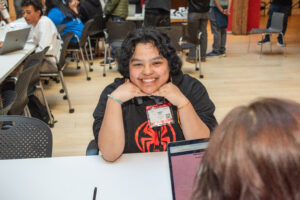
As the course continues, students start to look outward. They explore how AI is being used across industries, from healthcare to music to law, and begin to see how these tools show up in real-world settings.
They research, test, and compare results, learning to question what AI gives them instead of taking it at face value.
They also begin to understand what’s happening behind the scenes.
Students learn how different systems work, how models are trained, and how choices, especially around data, shape outcomes. They build their own models and see firsthand how bias can enter a system, not as an abstract idea, but as something they have to actively think through.
Throughout all of this, ethics isn’t treated as a separate topic. It’s part of the process.
If a team is building a mental health resource finder, they have to think about what happens when someone in crisis gets a bad recommendation— and design around that from the start, not after the fact.
By the end of the course, students bring everything together into a final project.
 Working in teams, they design and build an AI-powered product connected to a real problem or community. It’s a chance to take everything they’ve learned and apply it with intention.
The goal isn’t just to teach students how to use AI tools. It’s to help them feel confident building with them.
This class gives students a way in, not just as users, but as people who understand what they’re building and why it matters.
Know a high schooler who would be interested? Share this with a parent, teacher, or mentor in their life.